
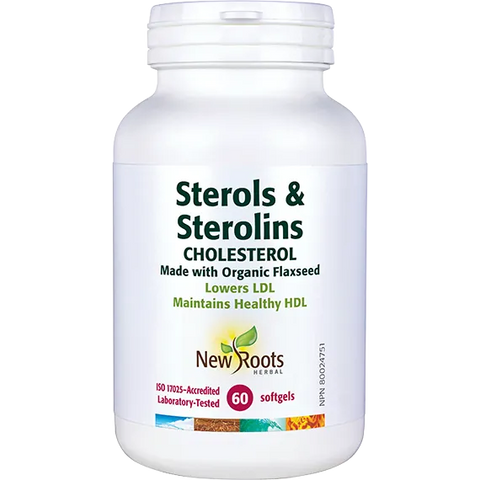
New Roots Sterols & Sterolins 60soft
You will find sterols and sterolins a popular addition to fortified functional foods. Recently, the FDA approved the following claim for phytosterols: “Foods containing at least 0.4 g per serving of plant sterols, eaten twice a day with meals for a daily total intake of at least 0.8 g, as part of a diet low in saturated fat and cholesterol, may reduce the risk of heart disease.”
Phytosterols help block the absorption of cholesterol from both your diet and what your body naturally produces. They work by making cholesterol in the intestine less soluble, causing it to turn into a form that the body cannot absorb. This process effectively reduces the amount of cholesterol that enters the bloodstream. It is based upon the fact that cholesterol must enter bile salt– and phospholipid-containing mixed micelles in order to pass through intestinal cells and be absorbed into the bloodstream.
New Roots Herbal’s Sterols and Sterolins Cholesterol is formulated with potency-validated ingredients, offering a full range of sterols and sterolins in their naturally occurring ratios. Additionally, flaxseed oil, rich in omega-3 fatty acids, complements these sterols to further support cholesterol management. Omega-3s in flaxseed oil contribute to maintaining healthy cholesterol levels, making it an essential addition to a heart-healthy regimen.
Organic flax ( Linum usitatissimum ) seed oil 666 mg
alpha -Linolenic acid 369 mg
Linoleic acid 109 mg
Free plant sterols (from non-GMO soy) 350 mg
beta -Sitosterols 151 mg
Campesterols 90 mg
Stigmasterols 88 mg
Other ingredients: Lecithin (from non-GMO sunflower oil) and beeswax in a softgel composed of annatto extract, sunflower oil, bovine gelatin, glycerin, and purified water.
You will find sterols and sterolins a popular addition to fortified functional foods. Recently, the FDA approved the following claim for phytosterols: “Foods containing at least 0.4 g per serving of plant sterols, eaten twice a day with meals for a daily total intake of at least 0.8 g, as part of a diet low in saturated fat and cholesterol, may reduce the risk of heart disease.”